Posted in category "Humor"

I have seen the abbreviation “LGBTQIA+” and had no idea what all the letters meant. I googled it and found that it is: “A common abbreviation for Lesbian, Gay, Bisexual, Pansexual, Transgender, Genderqueer, Queer, Intersexed, Agender, Asexual, and Ally community.” Is it time to get the “L” out, as some lesbians have suggested? I’m starting to think so.
What sparked this post was a Covid-19 article on Yahoo – “I am Worried About A Backslide in LGBTQIA+ Rights.” I thought it was a little whiny, self-centered and full of assumptions that all gay/lesbian people will agree with the writer’s fretting and values. I don’t. I want my female pronouns, thank you. I want my lesbian identity.
Our identity politics designation now encompasses splinter groups I personally have no interest in or connection with at all. Pansexual? Intersexed? Genderqueer? Who are these people? How was our movement for dignity, respect and rights hijacked? How could most lesbian and gay individuals relate to someone who describes themself as “Asexual?” The whole reason we endured pain, humiliation, rejection and violence was to have sex with the woman or man we desired who was a member of our own sex.
Many trans women are frustrated and angry with lesbians who refuse to have sex with them. There’s the trans woman with fire engine red lipstick complaining “cis” lesbians don’t respond to her OK Cupid ad! Then there’s trans professor bicycle champ who bitches about sex and sports. The trans woman porn star who coined the term “cotton ceiling,” is miffed that lesbians are happy to have coffee dates but not a roll in the hay. Most lesbians are not interested in dicks—either on a man or woman. Is that a big surprise? Anyway, shouldn’t a woman’s choice of whom she wants to sleep with take priority over ideology? 
I thought this gay man summed up the situation the best:
“I am a gay man, which means I am attracted to other men, meaning adult human males. This precludes women and females who identify as men. And you know what? That’s okay. I’ve fought since I was 15-years-old — when I first came out — to live this truth. My existence as a gay man matters. Lesbians’ existence matters. And this notion that we can overcome “genital preferences” is homophobic and erases our identities, as homosexual people. It doesn’t just echo the far-right conversion therapies so many of us have fought decades to end, it actively embraces these beliefs, as it implies we could become heterosexual if we just opened our minds and overcame our “preferences” for members of the same sex.” 
What do you think? Should lesbians be forced to sleep with men because that’s what the Church and Society want? Should lesbians be shamed into sleeping with trans women because that’s what some transgender advocates want?

Rules were a big thing growing up Catholic in the 1950s and 60s. Rules had to be followed, no matter how silly or irrational they were. The Church’s insistence on silly rules – missing one Sunday Mass would condemn a good person to Hell forever – did more to undermine Catholicism’s credibility than the conflagration of the 60s. Silly rules ultimately sapped believability.
An example of a silly rule is that females must have their heads covered in church. Going to church on Sunday was fine since I always had a chapel veil or bonnet; but going to church during the week presented a problem since I went to public school. I did not have a veil with me when I went to catechism class on Wednesdays. The sisters remedied that by requiring all girls without a veil to wear a tissue on their heads when we went into the church. The sisters handed out tissues as we entered the vestibule. We walked into the sanctuary with one hand on our heads to hold the tissue in place. I spent the lesson trying to keep the tissue on my head as we knelt or stood up. The drafts in the church didn’t make it easy. Obviously, the pastor and the nuns did not consider the impression that this exercise would make…what was important was that we followed the rule.
My revelation at age 10: having to wear a tissue on my head was stupid. It was my first step down the road of disbelief of other rules, including birth control, salvation limited to Catholic humans, chastity, and the secondary status of females in the Church.

At the beginning of April, a group of conservative Catholics began circulating an online petition called, “We Are an Easter People” demanding all U.S. bishops to “do everything you can to make possible some form of public Mass, especially the Easter liturgy, and then encourage pastors to conduct it” and to “demand that civil authorities recognize religious services as essential services.”
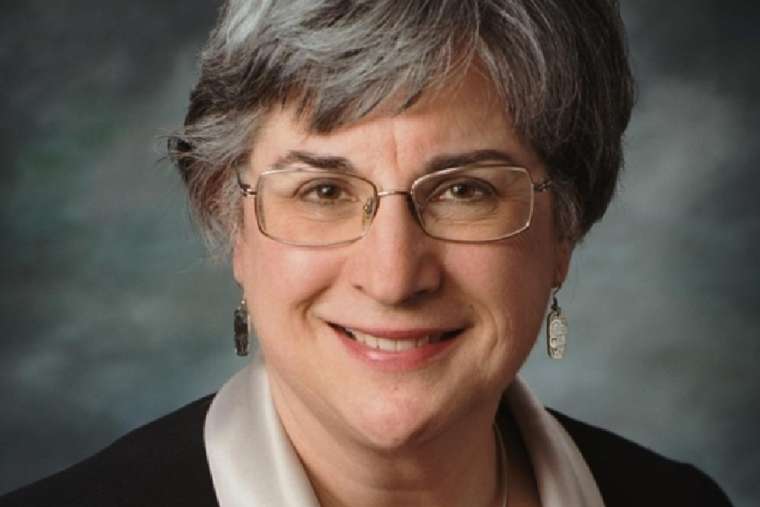
The author of the petition is Dr. Janet Smith, former professor of moral theology at Detroit’s Sacred Heart Major Seminary. Asked whether her use of the term “Easter People” meant she would like to see Mass on Easter Sunday, Dr. Smith said, “That is a beginning. Get the altars constructed in the parking lots or fields. Get the technology up and running that will broadcast the Mass. Is there any reason not to continue to offer Mass?” 
Smith didn’t want to put anyone at risk, but she observed that if we expect people to work in supermarkets, we can expect a priest to celebrate a Mass. “We can stay in our cars,” she said, “and he stays at the altar.” “We know many of our priests are eager to attend to those with Covid-19 and are willing to put their lives at risk. We admire their willingness to suffer and possibly to experience martyrdom.”
Dr. Smith notes that there are times when the state can impose restrictions, and one of those times is when there is danger in personal interaction. “But,” she added: “…we need to start with the right principle. Religion is an essential service – It is not just like a sporting event or concert that entertains us, that we can take or leave. The purpose of life is to be in a right relationship with the Lord. The sacraments are essentials means of sustaining that relationship. Unfortunately, whereas the founders of this country believed religious practice to be essential to the well-being of a nation and thus deserving of protection, too many in our culture think religion to be a pathetic superstition that does more harm than good. Such people are thrilled at any opportunity to wean religious believers from their practices.”
Ah, there it is, the crux of the matter. The image of the State telling Catholic conservatives what they can and cannot do, however it may affect other people. The Eucharist is central to their practice of Catholicism, both as a prize for the pure and a sanction against other believers who don’t share all their moral priorities. Is the essence of Catholicism only the assembly for the Eucharist, or Christ’s two commandments: to love God with your whole heart and soul, and to love your neighbor as yourself?
On April 5, 2020 The Wall Street Journal published “As Coronavirus Halts Masses, Conservative Catholics Push Back.” The comments by the Catholic subscribers were insightful and sometimes unintentionally hilarious:
“As seems to be often the case, conservative Catholics are espousing the “me first” doctrine spread by the U.S. president. One would expect Christians who love their neighbors as themselves would be doing everything they can to limit the spread of the virus. At present, in the absence of effective therapy or vaccine, it would seem right to steer clear of any gathering where one could pick up the infection and then carry it out to others.” – Jeffrey N.
“I attended just such an outside service a week ago. It was extremely well managed, with people spaced 6 feet minimum outside, hand sanitizer before approaching a gloved priest who used a tong to drop the host in the outstretched hand. Very dignified, and much safer than my earlier trip to the grocery store (in mask and gloves). No one came within six feet of each other. Very quiet, reverent and prayerful atmosphere. If you have no direct experience of this, I suggest you keep your opinion to yourself.” – Lisa A
“As the son of a devout, 93-year-old Catholic woman, I’m curious why some of these “conservative” Catholic voices are trying to rush my mom’s meeting with Jesus.” – Mike B.
“Public Mass pose a very significant risk of spreading the virus, so I agree with the shutdown here in Mpls/St. Paul. Even with seating everyone far apart during the service, in distributing Communion the Eucharistic Minister touches every person’s hand when he/she hands out the Host. The Host you receive has essentially been touched by everyone’s hand in front of you. Maybe there are creative ways around this to make it safer; I would be open to it. But if not done safely, this could be a disaster. – Monica M.
“What nonsense!” Have you ever attended mass before, the ministers just drop the host in the hands there is no physical contact, unless you choose to drink from the cup or shake hands. By your logic, you should not be touching anything at the grocery store or even the pharmacy as God knows who touched it before you. Also, you should not be touching the credit card machine with your credit card because God kows who swiped or inserted their card and germs there right before you! Bottom line, is that those who never let a crisis go to waste have put material needs like Costo and CVS before God. They and you will be answerable to the Almighty Judge for such poor judgement.” – Jacque D
“When I go to the grocery store and swipe my credit card I don’t immediately put my credit card or my hand in my mouth. I wash my hands first. That is the difference. And there is no “dropping” the communion in one’s hand. If so, there would be many more communions that fall all over the floor during Mass.” – Monica M.
“I thought the Roman Catholic church was pro-life?” – Jim M.

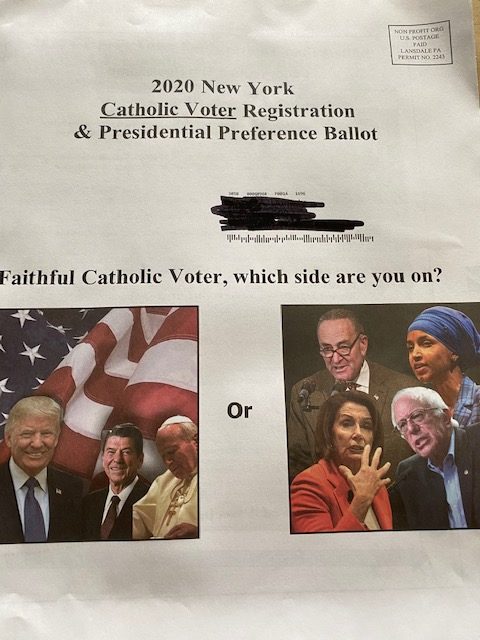
I received this mailer from Catholic Vote. I’m sure they got my name from my subscription to the National Catholic Register. I am a pro-life voter–not just a pro-birth voter. Catholic Vote started out as a Pope Benedict fan club. They have now evolved into some kind of conservative Catholic PAC.
When presented with such a stark choice for candidates it’s very easy to pick: NANCY PELOSI, and the fundamental Catholic values and upbringing she represents.
How on earth, as a faithful Catholic, could I vote for what Donald Trump, Ronald Reagan and John Paul II represent:
Donald Trump – A coarse, nasty, misogynist, pathological liar.
Ronald Reagan – The man who destroyed the American working class by opening the floodgates to globalization and corporate maximization of profits vs. giving people at home a decent living wage.
Pope John Paul II – Ignored or protected priestly predators and their enablers while thousands of innocent children, teens and seminarians were raped and sexually abused. Under his watch the Vatican bank was a den of thieves washing dirty money and funding luxurious lifestyles for corrupt prelates. And don’t forget–he never met a military dictatorship he didn’t prefer over poor peasants and indigenous peoples.
Catholic Vote needs to rethink their presentation materials.
As of March 17, 2020, 147 of the 177 U.S. dioceses suspended Masses to help stop new Coronavirus infections. This included the small Diocese of Tyler, Texas, population 105,000. 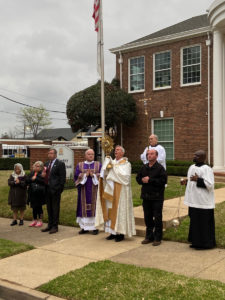
A week before, on March 11, 2020, Bishop Strickland tweeted his followers: “I call on every Catholic priest to lead a simple Eucharistic Procession around your Church sometime before the Feast of St. Joseph, March 19, for repentance, Christ’s healing hand on the Coronavirus & and that all men may be Godly, manly sons & disciples of His Son Jesus Christ.”
There was no report in any Catholic publications of additional Eucharistic Processions to help stop the Coronavirus and transform queens into rugged Marlboro men.
I counted eight people in a picture of Bishop Strickland’s procession – nine if you want to include the presence of the Lord Jesus. If this ritual made each of them feel better, good, but the group looked sad.
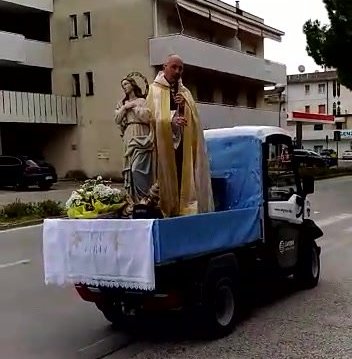
The funniest Catholic response so far to the Coronavirus is Father Andrea Vena, the parish priest of Bibione, a town near Venice, Italy. Fr. Vena loaded a statue of the Blessed Virgin Mary on his little truck, and drives around town to bless streets, houses and people. When he was stopped by the Carabinieri he barked, “I’m working!!” “Like Jesus,” he told a reporter, “I went out of the temple of God to go among the people.” 
The priest uses his aspergillum to spray holy water on people…. probably not a smart move since the virus is spread by contact of moist droplets infected by the virus.
One man watching a video of Fr. Vena commented: “You are a perfect example of why many non-Catholic Christians think all Catholics are loons. To all non-Catholic Christians reading here, we are not all loons. As you can see, some Catholics definitely are.”

The National Prayer Breakfast is a Washington, DC tradition that stretches back to 1953, when president Dwight Eisenhower established it at the suggestion of evangelist Billy Graham. It is a bi-partisan event with political, business and civic leaders coming together to pray. Many members of Congress normally attend.
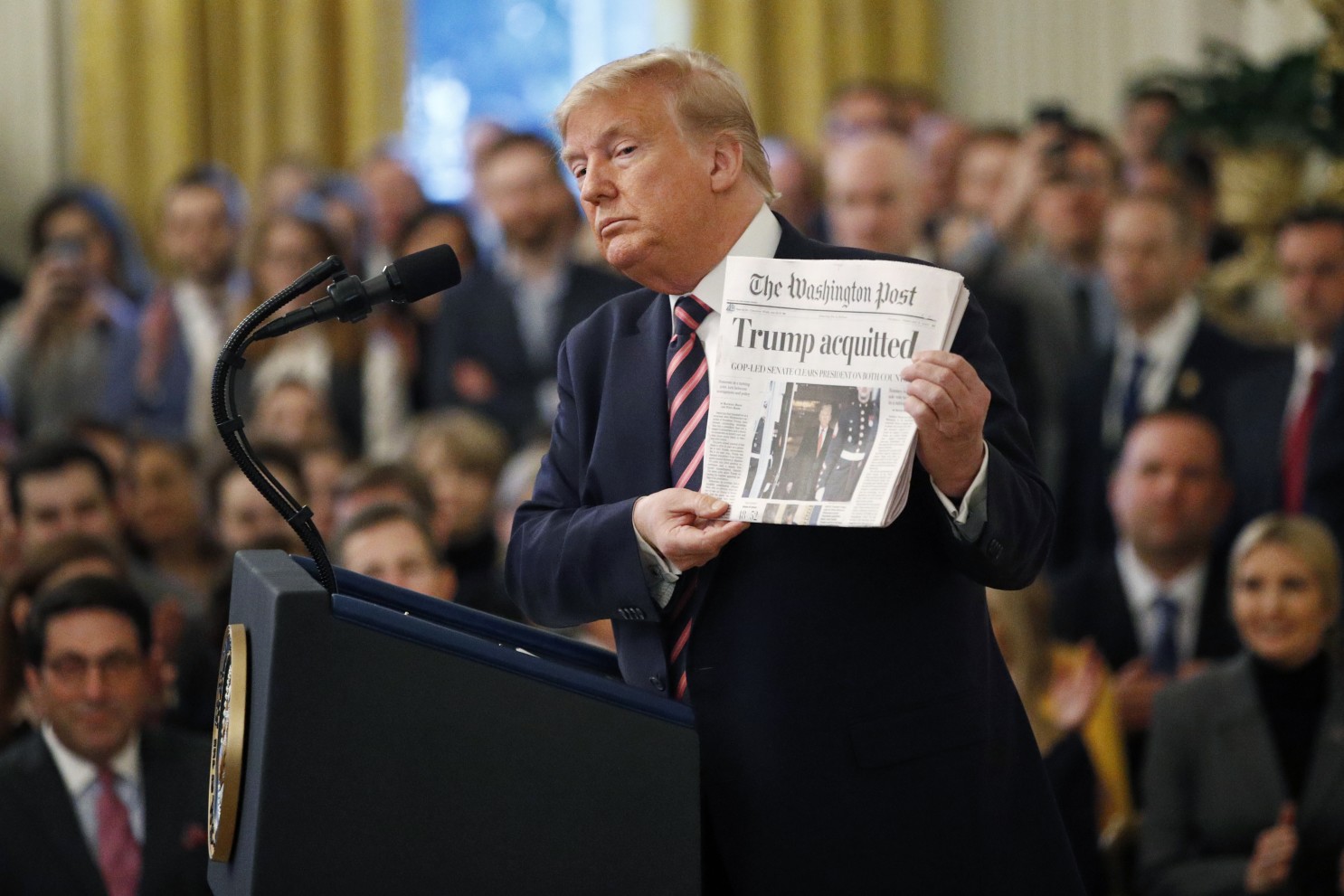
Yesterday’s breakfast had a different vibe. President Trump used the podium to attack supporters of his impeachment drive. “As everybody knows, my family, our great country and your president have been put through a terrible ordeal by some very dishonest and corrupt people,” Trump said. He scolded his opponents by saying impeachment supporters “know what they are doing is wrong, but they put themselves far ahead of our great country.” He added, “I don’t like people who use their faith as justification for doing what they know is wrong.” He went on, “Nor do I like people who say, ‘ I pray for you’ when you know that is not so.” The last jab was directed at House Speaker Nancy Pelosi, who has previously said she prays for him. 
Pelosi responded in a news conference after the event. She told reporters it was “completely inappropriate” for Trump to criticize people for looking to their faith as a basis for their decisions–“especially at a prayer breakfast.” “I pray hard for him because he’s so off the track of our constitution, our values, our country,” she said. “He really needs our prayers.”
I’m not sure all the prayers in the world will help our dysfunctional Congress, and the nasty, pathological liar we have for a president. President Trump is Roy Cohn resurrected.

Two lions were photographed after one mounted the other in a secluded bush area of the Masai Mara game reserve in southwest Kenya. Ezekiel Mutua, the chief executive of the Kenya Film Classification Board said: “These animals need counselling, because probably they have been influenced by gays who have gone to the national parks and behaved badly. I don’t know, they must have copied it somewhere or it is demonic. Because these animals do not watch movies.” He added, “That is why I say isolate the crazy gay animals, study their behavior because it is not normal. The very idea of sex even among animals is for procreation. Two male lions cannot procreate and therefore we will lose the lion species.” Mutua is known for his anti-LGBT statements and banning “pro-gay” movies. He recently banned “Rafiki,” a love story about two teenage girls in Nairobi. 
The “gay lions” photo was taken by wildlife photographer Paul Goldstein, a British guide for Exodus Travels. Goldstein said the lions first stood side by side, and then one lay down and was mounted by the other. This isn’t the first time two lions have been seen in a same-sex embrace. In March 2016, photographer Nicole Cambre snapped a male mounting and humping another male in Botswana. 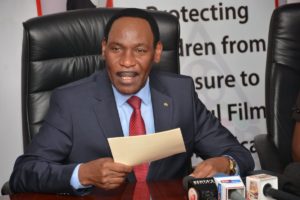
Craig Packer, the director of the Lion Center Center at the University of Minnesota observed that this kind of behavior among lions is rare. “It’s not really sexual and it tells us a lot more about those officials in Kenya and their homophobia than anything else. ” Packer said the photograph captured a moment of social bonding among male lions living in groups of two or three. These groups are called “coalitions” and members cooperate to drive off rival males and take over prides of females. Coalition males are typically affectionate, licking and flopping down on each other, Packer said. On occasion one lion will mount another. Packer speculated that the behavior seems to be a way to smooth over social tensions. Female lions do it, too, he said.
Pope Benedict XVI has contributed content to a new book, From the Depths of Our Hearts, which appears along with an essay by Cardinal Robert Sarah, the prefect of the Congregation for Divine Worship. The book, which was released this week, is an emotional defense of priestly celibacy. 
In an amazing coincidence, the book comes while Pope Francis is considering the possibility of allowing older, married men to be ordained as priests in the Amazon region.
What wasn’t mentioned in the book is an action Pope Francis’ predecessor, Benedict XVI, took almost 9 years ago to the day the book was published: he welcomed married Anglican priests who planned to convert to Catholicism. In other words, the same Benedict that is writing from the depths of his heart on the need for priestly celibacy was the first pope to allow married Anglican priests who converted to Catholicism to serve as Catholic priests. A small but revealing point: these same men left the Church of England because they wholeheartedly disagreed with the ordination of women and openly gay priests.
If this isn’t bad/funny enough, Cardinal Sarah and Archbishop Georg Ganswein, Pope Benedict’s good-looking and long-time private secretary, are engaged in a slap-fest over Benedict’s participation in the book. Did Cardinal Sarah use the 92-year-old, frail and mentally diminishing Pope Benedict in a fight against Pope Francis and/or to prop up book sales?
Archbishop Ganswein openly contradicted Cardinal Sarah’s official account of the genesis of the book, issuing a “clarification” on January 14, 2020 saying that while Pope Emeritus Benedict was certainly aware of Cardinal Sarah’s plan to produce a book on celibacy, Benedict “did not approve a project for a co-authored book and he had not seen or authorized the cover.” Archbishop Ganswein disclosed that he had, at the former pope’s request, asked Ignatius Press to remove the name of Benedict XVI as co-author of the book. Cardinal Sarah took a step back when he announced the same day on Twitter: “Considering the controversies that the publication of the book From the Depths of Our Hearts has provoked, it is decided that the author of the book for future publications will be: Cdl. Sarah, with the contribution of Benedict XVI.” So far, the publishers are standing firm with Pope Emeritus Benedict XVI as co-author. 
Cardinal Sarah’s pal, Archbishop Carlo Maria Vigano, has denounced Archbishop Ganswein for what he calls his “abusive and systematic control” of the pope emeritus. Of course, Vigano may still be smarting from the time Archbishop Ganswein told news media that contrary to Vigano’s claim, Pope Benedict did not confirm Vigano’s “testimony” on Pope Francis and the Cardinal McCarrick scandal. Ganswein said the whole thing was “fake news.”
Isn’t it fun to watch conservative prelates go picnicking on one another!

The Truth hurts!
The author missed my favorite: “The Church is not a museum.” (Pope Francis’ opening sentence at the Synod on the Family.)
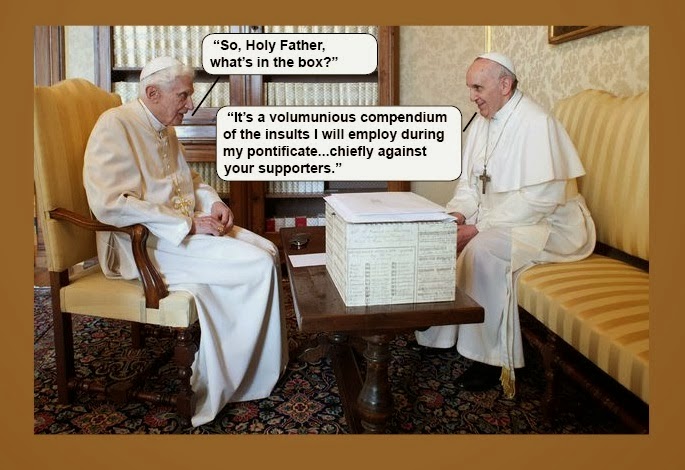
Enjoy the Little Book of Insults here.

This week’s Pious Trash award belongs to Father Paul Scalia of Arlington, Virginia for his review of The Day is Now Far Spent by Cardinal Robert Sarah. 
“Cardinal Sarah is a prophet of piety – of that virtue that prompts man to look joyfully to what came before him to receive with reverence what his fathers bestow. The cardinal himself displays a deep piety. He knows that what he has to proclaim is not his own but something received. Accordingly, he quotes heavily from St. John Paul II/Cardinal Ratzinger/Pope Benedict, and the Church’s tradition more generally. Piety remembers and preserves the gifts of the past. …. Cardinal Sarah’s look to the past is not just a nostalgic lament for what once was. It is a warning against being cut off from what makes us who we are: the Church’s saving doctrine and liturgical tradition, the Christian heritage of Europe, and, most of all, the family. …The current doctrinal confusion, ‘capitalist materialism,’ and gender ideology harm the poor disproportionately. As the ‘guardian of human nature’ the Church defends the world’s weak, powerless and poor by defending the truth about man.” 
Hmmmm. I thought the poor were harmed disproportionately by pollution, war, drug crime, human trafficking, lack of access to good food, jobs and education. Shouldn’t that be as much of a priority for the Church and churchmen as blasting society on condoms and lipstick?