Her Knight in Shining Armour – I Love a Happy Ending!

Be the First to Comment
Nihil ObstatLGBT Catholics – Bringing to light our hidden history.
Posted in category "Lesbians & Gays"Charlotte Mew’s Fearful Longings“Charlotte Mew: Madness and Sapphic Desire,” by Rebecca Batley introduced me to this slightly mad, brilliant, and reclusive poet. Almost immediately she reminded of some closeted Catholic lesbians that I have met. These women longed for love and sex but were fearful of acting on their desire. They were afraid of losing their respectability; and the tension between their religious faith and sexual need filled them with dread and a sense of loss. No wonder they were a little unhinged. Deeply closeted women often don’t read signs well, and can fixate on women who aren’t interested in them. This results in a predictable rejection. Charlotte “Lotti” Mary Mew was born on November 15, 1869, in London, England. Several of Mew’s siblings suffered from mental illness and were committed to mental institutions. This scared Charlotte and her remaining sister Anne, so much that they made a pact never to marry. In 1898, their father died without leaving any money for the family. This forced the Mews to rent out part of their home, and Charlotte took a job. As a schoolgirl, Charlotte fell in love with her headmistress, Lucy Harrison. Harrison herself fell in love with a teacher named Amy Greener, and they moved away. Mew had two other serious crushes: the writer Ella D’Arcy in 1898 and popular novelist and suffragette May Sinclair nine years later. Her loves were unrequited. There is no information on whether Charlotte’s physical longings were ever consummated with anyone, but her poem, There Shall Be No Night There describes a tender fantasy: “Then through my blood the coming mystery What interested me the most about Charlotte Mew was the tension between her religious belief and her lesbian desire. Tensions and strains between our physical and spiritual selves have ripped apart, wounded, or maimed many lesbians. Charlotte Mew was no exception. Does God love me for who I am and what I am? Many lesbians have concluded that the answer is “No,” and leave religion to end their isolation and painful loneliness. Mew stuck with religion but suffered. She believed, but she also carefully coded her desires and doubts in her poetry: “I think my body was my soul, “Madeleine in Church” by Charlotte Mew (1916) In 1926, her sister, Anne, was diagnosed with cancer. Charlotte took care of her until she died in 1927. After her sister’s death, she became deeply depressed and entered a nursing home. She committed suicide by drinking Lysol, a disinfectant. Charlotte Mew died on March 24, 1928, at the age of fifty-eight. Charlotte Mew is buried with her sister Anne in Hampstead Cemetery, West Hampstead, London. The epitaph reads, “Cast Down the Seed of Weeping and Attend.” The phrase is from The Divine Comedy by Dante Alighieri, translated by Henry Wadsworth Longfellow, Vol. II (Purgatorio), Canto XXXI (31). Dante meets his ladylove, Beatrice, and recalls his love for her. She admonishes him. “Cast down the seed of weeping and attend; “Never to thee presented art or nature The dismal reproach to follow a “higher good” instead of human love followed poor Charlotte Mew to her grave. I wish instead to provide her and her work and art a happier ending, inspired by Psalm 126:6 – “Those who go forth weeping, Almost 100 years after Charlotte Mew’s death, there are lesbians of faith who are married, enjoying the physical delights of a loving relationship, and looking forward together to the promise of salvation and eternal life. The Farmer’s Wife, a poem by Charlotte Mew read by Tom O’Bedlam
Andy Warhol’s Catholic InfluencesAndy Warhol is an influential and celebrated 20th century artist and pop icon. He was gay and was raised Catholic. His faith and sexuality influenced his art. As an adult, he did attend church from time to time, especially after he was shot and almost killed in 1968 by Valerie Solanas, a writer and radical feminist.  Andy Warhol with Bibles “Revelation” an exhibit at the Brooklyn Museum from November 19, 2021 to June 19, 2022, features Warhol artworks that are infused with both strains, often harmoniously and deeply revealing. The show was developed by the Andy Warhol Museum’s chief curator, Jose Carlos Diaz and curated at the Brooklyn Museum by Carmen Hermo. Some of the show’s highlights include Warhol’s two gigantic versions of “The Last Supper” in pink and yellow; and a fusion of the face of Christ, an advertising tagline, and a shirtless young man; and a shot-up, scarred Warhol reminiscent of Christ’s wounds or a martyred St. Sebastian. Much of Catholic dogma, art and religious expression is focused on the body. The sacrament of the Eucharist—eating and drinking Christ’s body—can have sexual overtones. Human figures in Catholic art history are often beautiful men, some in sexually suggestive poses. These influences went into Warhol’s formation as an artist and as a man, and he combined them with the pop arts trends of the day. Catholicism has inspired generations of homosexual artists through its sensual and sexually charged imagery.
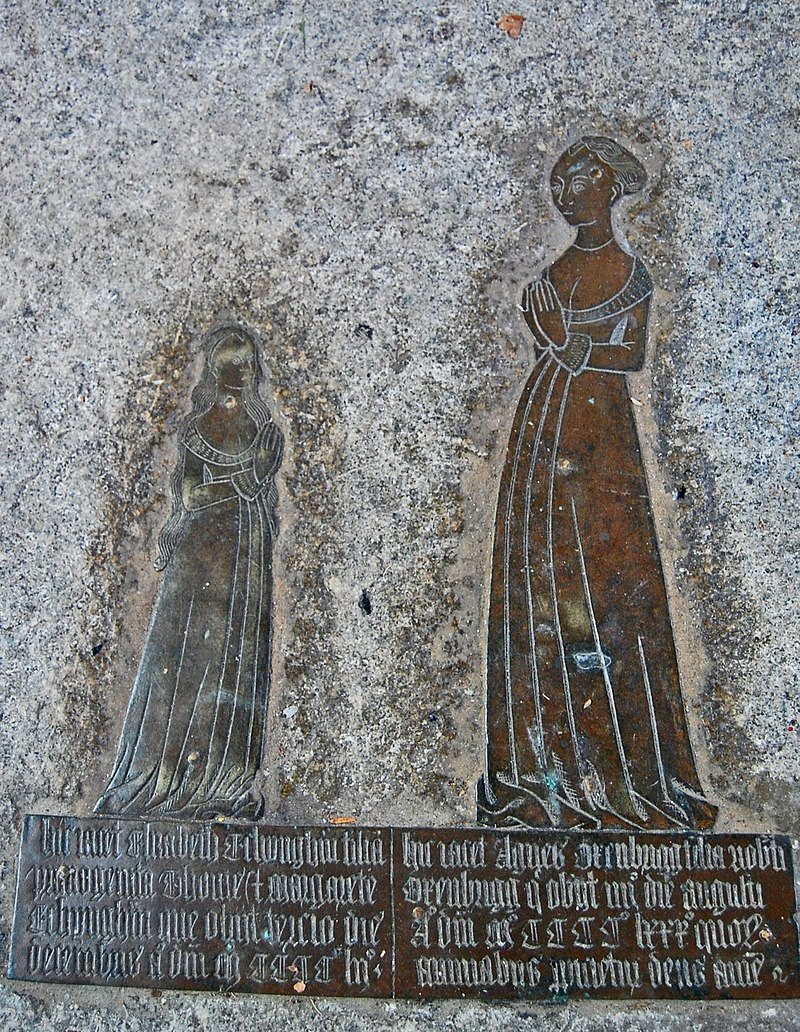
Memorial Brass of Elizabeth Etchingham and Agnes Oxenbridge
Elizabeth Etchingham and Agnes Oxenbridge were born in 1420s England. They may have met one another as girls or as teenagers. We cannot know for certainty the nature of their relationship, but the evidence in the brass memorial points to an intense, enduring, affectionate bond. Elizabeth Etchingham was in her mid-twenties when she died on December 3, 1452. Agnes Oxenbridge died almost three decades later on August 4, 1480. She was in her mid-fifties. Elizabeth and Agnes have a joint memorial brass on the floor of the side aisle of the Assumption of Blessed Mary and St. Nicholas Church at Etchingham. The brass is in front of the monument to Etchingham’s ancestors. Their memorial brass was designed in the style of married couples with one interesting detail: the women are shown facing each other and looking into each other’s eyes. Elizabeth’s head is lifted up slightly to gaze at the taller figure of Agnes, whose head is bowed slightly. Generally, married couples in that era were shown looking straight ahead. Agnes and Elizabeth appear to be in motion towards each other, with their skirts spread backwards and their bodies angled forward. The two women were dressed identically. The difference in size and hair styles of the two women most likely reflects their age difference at death. Loose, flowing hair was associated with young women; Agnes’ pinned up hair is seen on mature women. The lack of a head covering on either woman indicates that they were unmarried. The women must have expressed a desire to be buried together which the families honored. Agnes may have directed the design of the memorial brass. The intimate gaze of the two women evident as they move toward one another. The space between them was ended by death. The Mob Behind Dog Day Afternoon John Wojtowicz “I’m a Catholic and I don’t want to hurt anybody. Understand!” yelled Sonny Wortzik, the bank robber played by Al Pacino in the memorable 1975 movie, Dog Day Afternoon. Pacino’s character was based on John Mojtowicz, 27, who along with 18-year-old Salvatore Naturile, and Robert Westenberg, attempted to rob a Chase Manhattan branch in Gravesend, Brooklyn on August 22, 1972. Westenberg fled when he saw a police car. All three men were gay. The night before the robbery they all had sex together at the Golden Nugget Motel. In the movie, the main reason for the heist was to get money to pay for a male-to-female sex change operation for John Wojtowicz’s wife. That may have been part of Wojtowicz’s stated reason, but was it the whole truth? According to Liz Eden (born Ernest Aron), Wojtowicz’s transgender wife, Wojtowicz owed the Gambino family money. Some of that money went to pay for their December 1971 wedding, where they were married by a Roman Catholic priest. Liz Eden wore a wedding gown; John Wojtowicz his Army uniform and medals from the Vietnam war. According to the FBI, Wojtowicz met Naturile a month prior to the robbery at a gay bar called Danny’s, located on Seventh Avenue South in the Village. Naturile agreed to participate to get money to rescue his two sisters from foster care. The guns used in the robbery supposedly came from Mike Umbers, 37, a Gambino family associate who ran a club, bar and bookstore in the West Village. Umbers fronted several gay bars, callboy rings and pornography operations for the Genovese and Gambino organized crime families. Wojtowicz was friendly with Umbers, much to the chagrin of his fellow Gay Activist Alliance (GAA) members. Wojtowicz was known as “Littlejohn Basso” (Basso was his mother’s maiden name) at GAA.  Sal Naturile On August 26, 1972, this article about Wojtowicz’s Brooklyn heist appeared in the New York Times: “An acquaintance of John Wojtowicz—who has been charged with robbing a Chase Manhattan branch in Brooklyn last Tuesday and holding nine persons hostage—reportedly told the Federal Bureau of Investigation yesterday that an underworld figure supplied the guns used by Wojtowicz and two accomplices in the holdup.” “The acquaintance, Gary Badger, was questioned by F.B.I. agents yesterday afternoon, but the bureau would not comment. A friend of Mr. Badger, however, said that he told the agents that five men, including Wojtowicz, began planning the robbery last April, but that two of the men later bowed out. Wojtowicz was pressed to carry out the robbery by the underworld figure, who owns Greenwich Village bars and is involved in pornography, Mr. Badger reportedly told the agents. Mr. Wojtowicz owed the gangster money, he said.” Arthur Bell, a respected Village Voice columnist and investigative reporter, interviewed Badger, who showed up at a GAA meeting to make a plea for money to help bury his friend, Sal Naturile. Arthur Bell knew Wojtowicz through GAA meetings and dances. He interviewed Wojtowicz and published an article about the robbery in the August 31, 1972 edition of the Village Voice, “Littlejohn and The Mob, Saga of a Heist.” Wojtowicz described how he met a middle-aged Chase Manhattan bank executive at Danny’s. The executive told him how he could rob the branch of $150,000 to $200,000. The money in the bank’s safe was picked up early; so instead of the big payday only $29,000 was on hand. Bell also knew Mike Umbers, and interviewed him in 1971, a year before the robbery. The article, “Mike Umbers: Christopher’s Emperor,” described his start in the sex business; first as a pimp for high-class call girls and brothels, and then catering to gay men. Umbers had his run-ins with police and other crime families. According to the article, “Corruption, Before and After Stonewall,” Mike Umber’s Christopher’s End club was trashed by police. It was possible that police destroyed the interior with hammers and axes because Umbers wasn’t paying them off; or, the attack was ordered by Al Moss, also known as Abe Moss, who ran some gay bars for the Gallo crime family in the West Village. 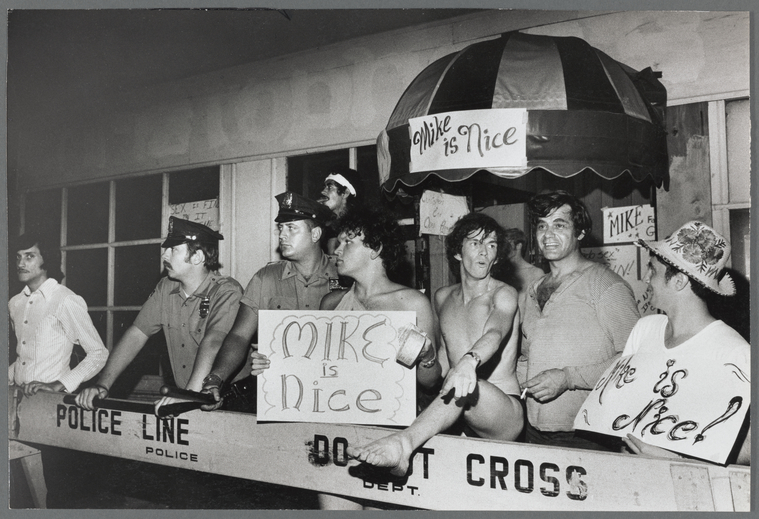 Mike Umbers (second from right) in front of Christopher’s End I was interested to read that Al Moss had a nephew named “Red” who paid the police $2,000 a month to protect The Barn, an after-hours club on Hudson Street. “Red” may be a reference to Red Mahoney, a long-time associate of Ed Murphy, who had his own checkered past as a gay blackmailer and gay activist. Mahoney worked with Murphy when he was alive and took over running the Christopher Street Festival after Ed died in 1989. Mahoney ran the Festival until 1992, when he became ill and stepped down. Mahony was a short, grumpy guy with dark red hair. He didn’t have Ed Murphy’s gregarious nature or command the same respect. The vast web of connections between the mob (Genovese, Gambino, Gallo crime families), their associates (Murphy, Mahoney, NYPD), front men (Umbers), expendables (Wojtowicz, gay hustlers) and gay clubs and bars before and after Stonewall continues to amaze me. The connections were essential to their multi-million dollar businesses of bars, clubs, pornography, prostitution and blackmail. Was the middle-aged Chase Manhattan executive who tipped off Umbers and Wojtowicz being blackmailed?
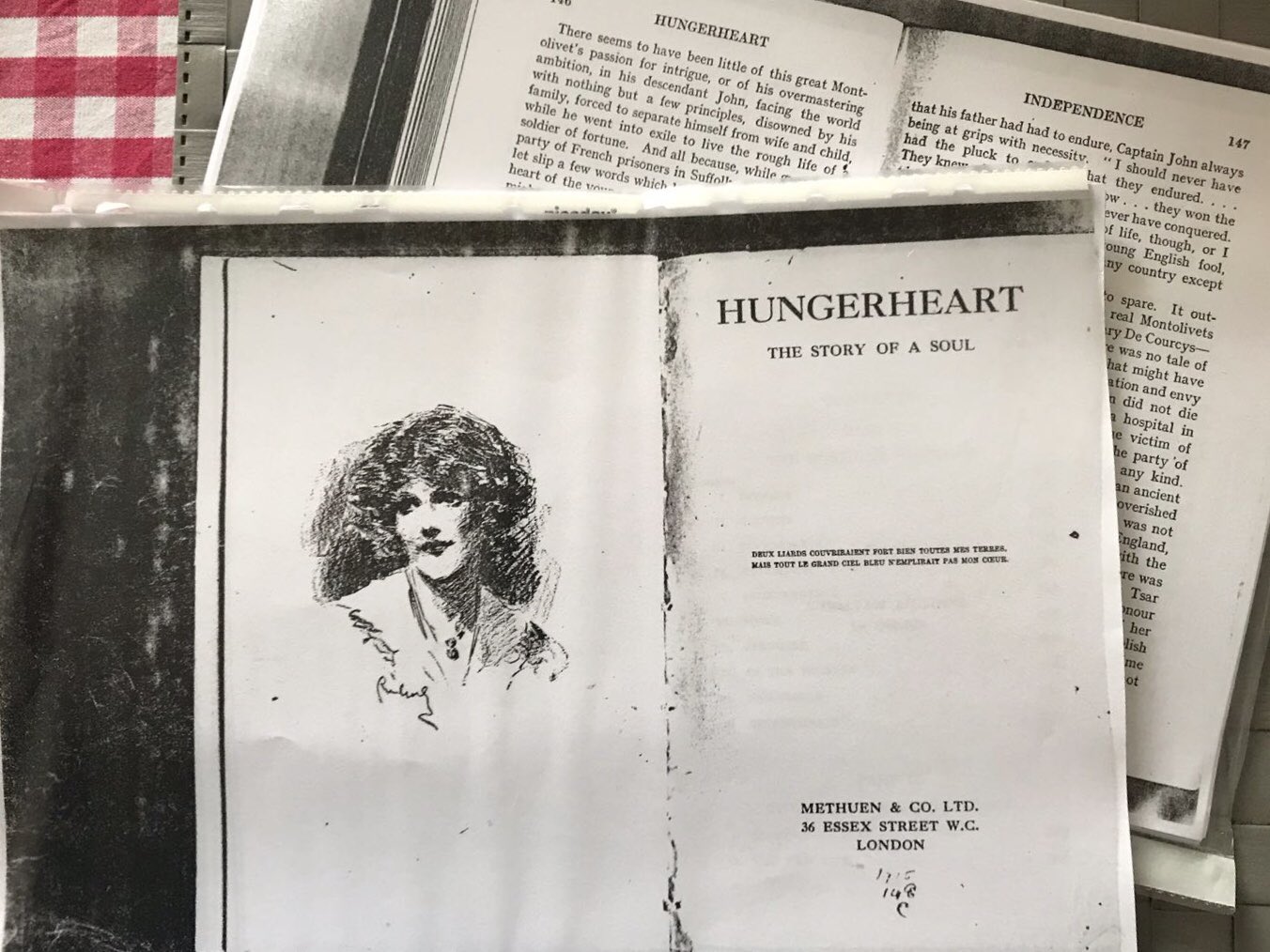
The First Catholic Lesbian Book: Hungerheart -The Story of a Soul
Hungerheart is a lesbian novel written by British author Christabel Marshall under her adopted male name, Christopher St. John. The book was published in 1915 in London by Methuen & Co. The novel is a first-person account of Joanna, “John” Montolivet that follows her search for love and passion. At one point she lives with Sally, a young actress, and they are “happy as a newly married pair, perhaps happier…” Sally decides to marry a man, and Joanna/John finds solace in the arms and bodies of stormy and dramatic women. Eventually she heads for quieter shores, and coverts to Catholicism. Her “friendship” with a young nun fulfills her heart’s hunger. “There are things that can be lived, but not chronicled, and our friendship is one of them,” Joanna/John describes. “Who in the world could understand our moments of union? Who in the cloister either? But they are understood in heaven…Thy love for me is wonderful, passing the love of men.” Hungerheart never achieved the fame of another book written a decade later by another Catholic lesbian—Radclyffe Hall’s, The Well of Loneliness. Only a few copies of Hungerheart survive in research libraries. For some odd reason, it was not tagged with a homosexual or degenerate label but cataloged as a work about “Catholic spirituality.”  Christabel Marshall The author’s book embodied her voracious love life. Christine Gertrude Marshall a.k.a. Christopher Marie St. John (1871-1960) was an English suffragette, a playwright and writer. After college, Marshall served as secretary to Lady Randolph Churchill and actress Dame Ellen Terry. Marshall became romantically involved with Dame Ellen’s daughter, Edith (Edy) Craig (1869-1947). The two women began living together in 1899. Marshall attempted suicide when Craig accepted a marriage proposal from composer Martin Shaw in 1903. Edith Craig was an actress, director, producer and costume designer. In 1912 Christabel Marshall converted to Catholicism and took the name, St. John out of affinity with St. John the Baptist. Her friend, Claire Atwood, converted around the same time. Atwood gave Una Troubridge and Radclyffe Hall, another Catholic couple and close friends, a relic of the true cross acquired by her ancestors from a pope. Una put it with candles and flowers in a shrine in her bedroom. In 1916, artist Claire (Tony) Atwood (1866-1962) moved in with Craig and Marshall. Their menage a trois lasted until Craig’s death in 1947. Una Troubridge used to call them, “Edy and the boys.” They often wore men’s attire to match their male names. “Miss Craig,” wrote Virginia Woolf in her diary, “is a rosy, ruddy ‘personage’ in white waistcoat, with black bow & gold chain loosely knotted.” Marshall wrote rhat the three women “achieved independence within their intimate relationships…working respectively in theatre, art, and literature, and drew creative inspiration and support from one another.” 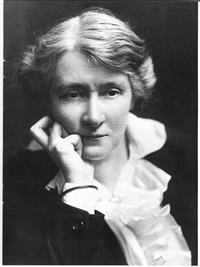 Edith Craig In 1932, when she was sixty-one, Marshall fell madly in love with Vita Sackville-West, a member of the Bloomsbury Group and a successful poet and writer. Their affair continued for several years and caused huge fights between Marshall and Craig. Atwood unsuccessfully tried to serve as a peacemaker. In 1935, under her male name, Christopher St. John, Marshall wrote a biography of a distinguished physician, Dr. Christine Murrell, the first female member of the British Medical Association’s Central Council. Titled, “Christine Murrell, M.D., Her Life and Work,” St. John/Marshall wrote the dedication to both of Murrell’s lovers: Honor Bone, M. D. and Marie Lawson, a printer, editor, and tax resister. Like St. John/Marshall, Murrell had a threesome household. Christabel Marshall/Christopher St. John died in 1960. She is buried next to Claire Atwood at St. John the Baptist’s Church, Small Hythe, England. This is the church where Dame Ellen Terry worshipped and where her funeral Mass was held in 1928. Edith Craig’s ashes were supposed to be buried there as well, but by the time of Marshall’s and Atwood’s deaths, they had been lost. A memorial was placed in the cemetery instead. Why did so many Anglican clerics, creatives and/or socially prominent gays and lesbians convert to Catholicism in the Victorian and Edwardian eras? The Catholic Church has always been opposed to homosexual sex; but it also has been tolerant of gay sex among its members, including priests, the hierarchy and religious, as long as they were discreet and parroted official teaching in public. At that time, being Catholic was a little naughty, not socially acceptable, and showed a streak of rebellion and independence. Creatives were drawn to the sensuousness, the pageantry, and the mysteries in Catholicism. Catholicism emphasizes the body—the body of Christ in our mouth, the bodies of saints who give themselves up to pain and ecstasy, the homoerotic images found everywhere there are Catholic artists and cathedrals. For women, Catholicism offers many role models of women who lived full and fulfilling lives—without men.  Christopher St. John’s Shrine
The Catholic, Fruit-Flavored Liberace!
In 1959, the flamboyant entertainer, Liberace, sued the Daily Mirror, a British paper, for insinuating that he was a homosexual. Daily Mirror columnist, William Connor, writing under the pen name, Cassandra, described Liberace as “…the summit of sex – the pinnacle of masculine, feminine and neuter. Everything that he, she, and it can ever want…a deadly, winking, sniggering, snuggling, chromium-plated, scent-impregnated, luminous, quivering, giggling, fruit-flavoured, mincing, ice-covered heap of mother love.” In court, Liberace denied being a homosexual (“I’m against the practice because it offends convention and it offends society”) and sued for libel. He won and was awarded £ 8,000. Liberace skipped off and coined his famous saying, “I cried all the way to the bank.” To the day of his death from AIDS in 1987, Liberace denied he was gay. He belonged to the generation of show business homosexuals (Rock Hudson, Tab Hunter, Anthony Perkins, Barbara Stanwyck, Katharine Hepburn, Agnes Moorehead..) who believed that their personal lives were private, and certainly not political. Liberace’s Catholic upbringing may have had a hand in shaping his attitudes, but so did social mores of post-World War II America. Actors and entertainers’ contracts included morals clauses. If they were exposed as homosexuals, their careers were over and they were economically ruined. “I don’t think entertainers should publicly air their sexual or political tastes,” said Liberace. “What they do in the privacy of their home or bed is nobody’s business.” He encapsulates the institutional Catholic philosophy of homosexuality for both clergy and laity: flirt, enjoy romance, have sex with tricks and lovers, but always deny your homosexuality and condemn it in others. Above all, say nothing political. This practice was most recently on display with the outing and resignation of Monsignor Jeffrey Burrill, the general secretary of the U.S. Conference for Catholic Bishops in July 2021. Burrill was exposed through his cellphone data which indicated that he had repeatedly used his Grindr app to find men and had visited gay bars and bathhouses. Wladziu Valentino Liberace (May 16, 1919-February 4, 1987) was the highest paid entertainer in the world at the height of his fame in the 1950s-1970s. Born in Wisconsin to parents of Italian and Polish origin, “Mr. Showmanship” was known for his excesses on the stage and off. After watching a movie about Frederic Chopin in 1945, Liberace made the candelabra his symbol, always on his piano during a performance. But he was best known for his elaborate, sensational costumes. There was a “King Neptune” costume; a red, white, and blue hot pants outfit; one of his favorites called the “lasagna” costume, which featured a cape that fanned out when he spun around. Two of the most “over the top” capes were designed by Liberace’s dear friend and furrier, Anna Nateece. One was white fox fur with a train 12 feet wide and 16 feet long. The second was made from 500 mink skins and weighed over 150 pounds. They were both trimmed with rhinestones. His homes exhibited the same excess. Mirrored walls, a marble quarry’s worth of floors, colonnades and fixtures, a casino with a slot machine jackpot of three candelabras, a canopied bed with an ermine spread. On the bedroom ceiling was a reproduction of the Sistine Chapel with Liberace’s face among the cherubs. Liberace loved dogs and had about 20 of them between his Las Vegas and Palm Springs houses. They must have had a hard time skidding and slipping on the shiny marble floors. Liberace was camp before the word came into wide-spread use. When the word first appeared in the early 20th century, it denoted “ostentatious, exaggerated, affected, theatrical, effeminate or homosexual behavior.” In the 1966 Batman television series with Adam West as Batman and Burt Ward is the Boy Wonder—the campiest show ever–Liberace played a dual role as a concert pianist, Chandell, and his gangster-like twin, Harry, who was extorting Chandell into a life of crime as “Fingers” in the episodes “The Devil’s Fingers” and “The Dead Ringers.” According to Joel Eisner’s The Official Batman Batbook,” they were the highest rated of all the show’s episodes. The show had huge homosexual overtones as well. Burt Ward speculated in his book, My Life in Tights, that Batman and Robin could have been lovers. What drew fans to Liberace was not only his flamboyant and outrageous costumes and act, but his warm, gracious, polite, and down-to-earth way of speaking to fans and his audience from the stage or television. “I talked to my viewers as if they were my friends, my next-door neighbors,” he said. Liberace gave a hint to one of his connections to Catholicism when he once remarked on religion: “There will always be the need for people to worship,” he said, “whether it’s religion, an entertainer or a movie star. I’ve always felt close to religion because it’s a form of show business.” The late Bishop Fulton J. Sheen, Mother Angelica and even Bishop Robert Baron of Word on Fire could appreciate that statement. But when it comes to costumes, Liberace undoubtedly would feel closest to Cardinal Raymond Burke with his 20-foot train of watered silk, scarlet gloves, and jeweled red hats. In November 1963, Liberace almost died from kidney failure during a performance in Monroeville, a town right outside of Pittsburgh, PA. The day before he had been cleaning his costumes in an unventilated room with a toxic cleaning solvent. The deadly fumes nearly killed him. He collapsed onstage and was rushed to St. Francis Hospital. Liberace was hooked up to a new device – a dialysis machine – and given a 20% chance of surviving. His doctors told him to get his affairs in order. “I took it very philosophically,” Liberace said. “I had led a good life, made a lot of people happy, and I had no regrets.” He described one experience during his hospital stay in his autobiography, The Wonderful Private World of Liberace that was a turning point in his recovery: “A very young and lovely nun wearing a white habit came to see me late one night, when I was very near death. She said that she was going to pray to Saint Anthony for me, and that he would make me well. The very next day, I began to get well. I described the nun to Mother Superior at the hospital and asked who she was. The Mother Superior said, ‘There are no nuns in the hospital who wear white habits.’” Dialysis took off after it saved Liberace’s life, and St. Francis Hospital gained a new, life-long patron. Liberace raised money for the hospital, financed a new intensive-care ward, and made sure that the sisters had tickets whenever he performed in Pittsburgh. Soon after his Monroeville hospital stay Liberace was snared by sexual blackmailers. “The Chickens and the Bulls” extortion scheme is forgotten now, but it was a scandal in the mid-1960s. In a New York Times article published on March 3, 1966 – “Nationwide Ring Preying on Prominent Deviates,” a celebrity believed to be Liberace is described. “A TV celebrity, a twinkling star who has millions of female fans all over the world, refused to take the witness stand. However, he did tell investigators that he had paid blackmailers more than $20,000. “I can afford to lose the money,” he said, adding: “I hope they die of cancer.” That incident didn’t slow Liberace down. He had affairs, tricks, and romances, taking in live-in lovers, usually blond, blue-eyed young men with strong physiques. One of his lovers, Scott Thorson, said Liberace’s first sexual encounter was with a Green Bay Packer football player. Thorson is also the source for a story of an affair between Liberace and Rock Hudson. 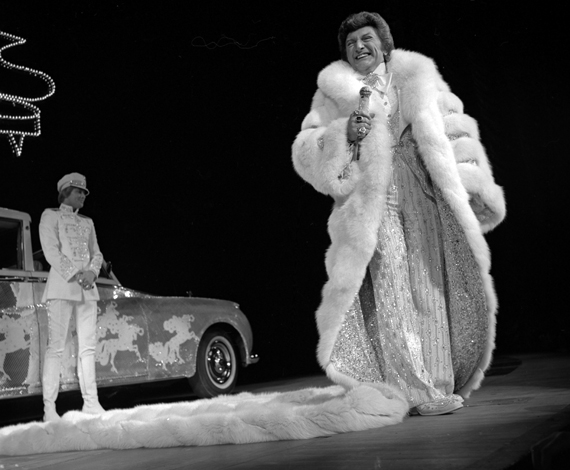 4/17/79 Scott Thorson, 62, met Liberace in 1976 when he was 17. When he was 18, Liberace hired him to act as his personal friend and companion. He also incorporated Thorson into his Las Vegas performances. Thorson would don a chauffeur’s uniform covered in rhinestones and drive Liberace on stage in a Rolls Royce. The five-year relationship ended in 1982, when Liberace had members of his retinue forcibly eject Thorson from his Los Angeles penthouse. Thorson admitted that at least part of the reason for the breakup was his drug addiction. But Scott Thorson wasn’t finished with Liberace. Shortly after he was dismissed/dumped, Thorson filed a $113 million dollar lawsuit against Liberace, the first same-sex palimony suit in U.S. history. Liberace continued to deny that he was a homosexual and insisted that Thorson was never his lover. The case was settled out of court in 1986, with Thorson receiving $75,000 in cash, three cars and three pet dogs. Thorson sniped that Liberace was a “boring guy” in real life, and mostly preferred to spend his leisure time cooking, decorating, and playing with his dogs. In August 1985, Liberace was secretly diagnosed as HIV positive. Cary James Wyman, his alleged lover of seven years, was also HIV positive and died in 1987 at the age of 33. Another alleged lover, Chris Adler, came forward after Liberace’s death and claimed that Liberace had infected him with HIV. Adler died in 1990 at age 30. Besides his long-term manager, Seymour Heller, private physician, Dr. Ronald Daniels, and a few family members and close friends, Liberace kept his HIV positive status a secret until the day he died and did not seek any medical treatment for it. Urged by a former boyfriend to admit that he was sick, he refused, saying “I don’t want to be remembered as an old queen who died of AIDS.” Liberace died on February 4, 1987 at The Cloisters, his home in Palm Springs, California. He was 67 years old. His death was initially attributed to anemia from a watermelon diet, and emphysema and heart disease from chain smoking. However, the Riverside County coroner performed an autopsy and while emphysema and coronary artery disease were present, the real cause was pneumonia due to complications from AIDS. Liberace received the Last Rites a few days before he died. “He had the rosary wrapped around his right hand. There was no jewelry. The rosary beads were his jewelry,” said his publicist, Jamie James. Within hours of his death, his body was taken from his home directly to Forest Lawn Memorial Park in Los Angeles. He was buried on February 7th and is entombed with his mother and brother, George. The marble façade has the very enigmatic epitaph: “Sheltered Love.” A memorial service for Liberace had been held the day before at Our Lady of Solitude Church in Palm Springs. Two stars were present – a neighbor, actress Charlene Tilton from the television series, Dallas, and Kirk Douglas. There was a second memorial service at St. Anne’s Church in Las Vegas on February 12th, with Debbie Reynolds, Donald O’Connor, Robert Goulet, Rip Taylor and Sonny King in attendance. In contrast to his glittery public life, Liberace’s burial was private, and his memorial services were quiet and low key. I agree with Liberace that not everyone is called—or should—make their private life public. Like most gays and lesbians of his era, he lied about or denied his homosexuality. That is an unadmirable trait, but understandable in the context of his time, his entertainment career and his faith. Except for a despised handful, there were no gay rights supporters, no “out” showbusiness people, religious, public figures, or academics until deaths from AIDS began in the 1980s and the gay and lesbian rights movement began to pick up momentum. His longtime publicist, Jamie James, once said, “He had this image, but he was no sissy. You have to be a pretty strong, brave person to wear what he wore and act like he did during those days. You had to have guts, believe me.” Reading: Liberace Cooks! – A Cookbook by Liberace. 1970 Liberace: An Autobiography by Liberace. 1973 The Wonderful Private World of Liberace by Liberace. 1986 Behind the Candelabra: My Life with Liberace by Scott Thorson. 1988. Liberace: The True Story by Bob Thomas. 1988 Liberace: An American Boy by Darden Asbury Pyron. 2000 Rocking the Closet: How Little Richard, Johnnie Ray, Liberace and Johnny Mathis Queered Pop Music by Vincent L. Stephens. 2019
. The Perils of Social Media
Monsignor Jeffrey Burrill, the former general secretary of the U.S. Conference of Catholic Bishops, used Grindr, a gay male dating and sex hookup app, at his office, home and while on trips for the USCCB. In his position at the USCCB, Burrill played a key role in coordinating national and diocesan responses to sex abuse and coercion scandals. He and several senior USCCB officials met with Pope Francis Oct. 8, 2018 to discuss how the conference was responding to ecclesiastical scandals related to sexual misconduct, duplicity, and clerical cover-ups. On June 20, 2018, the day the McCarrick sex scandal became public, Burrill’s cell phone emitted hookup app signals at the USCCB staff residence, and from a street in a residential Washington neighborhood! He traveled to Las Vegas a day or two later. On June 22, the mobile device associated with Burrill emitted signals from Entourage, which bills itself as Las Vegas’ “gay bathhouse.” Burrill resigned on July 20, 2021, after The Pillar, a Catholic investigative journalism site, revealed the extent of his almost daily Grindr usage. “If someone who has made the promise of celibacy or a vow of chastity has a dating app on his or her phone, that is asking for trouble,” said Cardinal Joseph W. Tobin of Newark, NJ at a Zoom panel organized by Georgetown University. The Pillar tried to reveal a few more Grindr exposés of priests in the Newark archdiocese and in the Vatican but they were squelched. Less than a month later, another clerical higher up made the news: “Pope replaces Bishop After Video of Him Masturbating on Zoom Call with Another Man Leaks on Social Media.” Tome Ferreira de Silva, the bishop of the Diocese of Sao Jose do Rio Preto in Brazil, had previously been accused of having an affair with a young man working as his driver and ignoring credible allegations of local priests having sex with teenagers. The video was released to a local TV station. A still of the video shows the bishop playing with himself. Several previous Vatican investigations of the bishop came to nothing. Monsignor Burrill slunk off without saying anything. Bishop Ferreira de Silva publicly groused about his exposure. When I read these stories and exposés a favorite saying from Lily Tomlin (another lesbian!) springs to mind: “No matter how cynical I get I can’t keep up!”
Meeting Archbishop John J. O’Connor Archbishop O’Connor, 1984 John J. O’Connor, Bishop of Scranton, Pennsylvania, arrived in New York City in January 1984. He was named Archbishop of New York shortly before his installation and made a cardinal by Pope John Paul II in 1985. O’Connor stayed in the news, and in the center of multiple controversies until he died in 2000. He was very passionate about several issues, particularly opposition to abortion and support of organized labor. He also didn’t mince words about lesbian and gay people: no hiring, housing, or civil rights protections. From the start he was a relentless foe of Mayor Edward Koch’s Executive Order 50, a directive which prohibited “agencies that receive city funds from discriminating against homosexuals in employment.” Although he denied it, O’Connor pressured Francis Mugavero, Bishop of Brooklyn, to shift his diocese’s stance of engagement with gay people to stiff opposition to legal protections. In February 1984 they issued a joint statement in which they claimed that the gay rights bill was “exceedingly dangerous to our society,” explaining, “We believe it is clear that what the bill primarily and ultimately seeks to achieve is the legal approval of homosexual conduct and activity, something that the Catholic Church, and indeed other religious faiths, consider to be morally wrong. Our concern in this regard is heightened by the realization that it is a common perception of the public that whatever is declared legal, by that very fact, becomes morally right.” Archbishop O’Connor was very clear on his position about homosexuals in the church’s employ–“We have said repeatedly that we have no problem whatsoever in employing people admitting to or not admitting to homosexual inclinations. If an individual avows engagement in homosexual activity, then we want to be able to say whether or not we will employ that person in this particular job, and we feel this is a perfectly appropriate thing for any agency. You know, we have five thousand, seven hundred youngsters in child-care agencies, and they are the ones currently at issue.” O’Connor said it would be wholly alien to Catholic teaching to employ in a child-care agency someone who openly advocated homosexuality. In September 1984, I was a member of a delegation from the Coalition for Lesbian and Gay Rights (CLGR) who met with Archbishop O’Connor at the New York Catholic Center to discuss Executive Order 50. Terrence Cardinal Cooke, O’Connor’s predecessor, had refused to meet with Dignity/New York to discuss it. Coalition representatives were packed with Catholics, some of whom were members of Dignity and the Conference for Catholic Lesbians (CCL). When we arrived at the building, all in business attire, the guard at the door waved us through saying, “This way, ladies, or whatever…” As we got on the elevator, someone who knew who we were and where we were headed whispered, “Good luck.” We were ushered into a conference room to wait for Archbishop O’Connor. I had a seat toward the end of the table facing the door. I saw Archbishop O’Connor striding down the corridor towards the meeting room. He was alone; no aides accompanied him. He looked grim. I don’t know what possessed me, but I winked at him. He winked back! We smiled. O’Connor walked into the room and walked around the table shaking everyone’s hand. I thought, “Perhaps there’s hope.” He sat down and the meeting started. I can’t remember what was said, but all our arguments and personal experiences of ridicule, threats, and rejections by our friends, family, co-workers and faith based on our sexual orientation didn’t affect him. He said something to the effect that the Church would never accept us in the way we wished to live. The table went totally silent. It was a stunning moment; I felt the pain from his statement totally wash over me. I cried. Several other people at the table also cried, including a man who had recently lost his children in a custody battle. I turned to look at Archbishop O’Connor and saw that he looked surprised. He may have thought that our firmness and anger at our Church meant that we hated it or didn’t care. The opposite was true. There was nothing else to say and we left. A few weeks later, I decided to write him a thank you note for the meeting. I told him I appreciated that he met with us and listened to what we had to say. I also said that while we strongly disagreed, I had respect for him for his straightforward expression of what he believed. Three weeks later I received a reply to my letter. Dear Karen: Your letter…was extraordinarily kind and touched me deeply. I am indeed grateful. It is my sincere hope and prayer that through the years ahead I will be able to serve you in some way that you will consider helpful. My convictions about Church teaching are very deep. I do not anticipate a change in such teachings, and neither do I see it precluding our loving one another as brothers and sisters in Christ. Please believe that I will give deeply sincere consideration to any recommendations that can help us in that regard in accordance with the tenets of the church which I am certain we both love. You and your associates are very much in my masses and my prayers, and I ask that you keep me in yours as well. Faithfully in Christ, John J. O’Connor We never spoke, or saw one another again, but the experience of meeting Archbishop O’Connor helped to guide me on how to engage with others with whom I don’t agree: -Listen to adversaries as well as friends. One discussion may not change any minds, but it will have an impact and it shows a basic respect and courtesy. -Look for the good in people. See a whole person, not just an opinion or point of view. -Persevere. The Coalition members at the O’Connor meeting continued the fight for gay and lesbian civil rights. Dignity and CCL continued to work for the respect and recognition of lesbian and gay people in the Church. On March 20, 1986, the New York City Council passed a homosexual rights bill by an unexpectedly wide margin of 21 to 14. The bill forbade discrimination based on sexual orientation in housing, employment, and public accommodations. The bill did provide an exemption for religious institutions. The fear that the Archdiocese of New York expressed came true: public protections guaranteed by law did change public perception of lesbian and gay people. The widening acceptance and protection encouraged people to live and love more openly. As more and more gay people came out to their friends, family and colleagues, media portrayals also changed, which encouraged even more people, and younger people, to come out. In 2013, even the highest level of the Church changed. In response to a question from the news media about a gay priest, Pope Francis made the statement, “Who am I to judge?”
Finding Our Place as Catholic Lesbians: Chapter 8 – “Ephphatha” – Be Opened
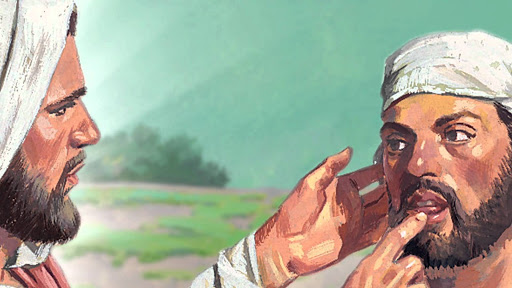
The need to speak, to be heard, to be brought out of silence and isolation into openness to God and others was one of Jesus’ miracles, perhaps one of his most important works. In the Gospel of Mark (7:31-37) there is one small, but very important word – a word that in its deepest meaning sums up the whole ministry and message of Christ. This word, “Ephphatha,” means “Be opened.” The gospel reading says: “Again Jesus left the district of Tyre The historical and literal meaning of this passage is that, thanks to Jesus’ intervention, a deaf mute’s ability to hear and to speak were restored. Before he had been closed, isolated, and limited in his ability to communicate. His recovery brought him an “openness” to others and to the world, and through his new ability to communicate, he would relate to the world in a new way. On a spiritual level, this passage describes the closing of the deepest core of a person, what the Bible calls the “heart.” It is the heart that Jesus came to liberate— to “open” —to enable us to fully live our relationship with God and with others. It is a gesture of healing we remember and honor every time the Gospel is read: Open my mind, my mouth, my heart, to receive your holy words. This miracle stands in stark contrast to much of the hierarchy of the church, which does not want to hear what women, gay people and their advocates have to say, which wants to remain deaf, and which also wants these same groups to remain mute. Perhaps the openness that inspires Pope Francis to reach out to people on the margins, to hear the words of different kinds of people, to engage those of us that have been closed off is the miracle for which we have been waiting. Read the entire article – The Importance of Being Who We Are – Finding Our Place as Catholic Lesbians. |